
Us, as Germans, have a word for almost everything, that is why the German government refers to electrifying heat as “Wärmewende” (heating transition or changing heating). Of course the “Wärmewende” includes both industrial and consumer heat, But for today, let`s talk about “consumer heating” or more specifically.. heating buildings making use of heat pumps.

Heat pumps function like reversed refrigerators. There are those that are air-based like a reverse air-conditioner and those that are ground-based, drilled into the ground and taking advantage of in-ground temperature differences.
The IEA (1) explains why heat pumps are so important: “Heat pumps, powered by low‐emissions electricity, are the central technology in the global transition to secure and sustainable heating. Heat pumps currently available on the market are three‐to‐five times more energy efficient than natural gas boilers.”
There are three important statements here (not in order): Heat pumps…
- … are 3 to 5 times more efficient than natural gas heating
- … have to be powered by “low-emission electricity”
- … have to be secure and sustainable
I will discuss all three points, but let’s be clear, to become more energy efficient is a goal we should all share. If there are ways to heat our homes (also pertaining to industry heating ) more energy efficient, then we should take advantage if this immediately, without a second thought.
Fact 1: Transferring heat from place to place may take 3x less work (or energy) than cooling or heating directly.
Heat pumps are envisioned as replacements for fossil fuels (oil, coal, gas), heating our homes by utilizing “renewable” electricity mostly produced from wind and solar to power heat pumps. The reason why everyone is talking about using heat pumps rather than oil or gas for heating, is because we are trying to reduce “CO2 emissions” in order to reduce a projected warming of our planet in order to reduce projected sea-level rise and projected extreme weather conditions.
As always, for the discussion on climatic changes, causes and impacts, I refer to Prof. Steven Koonins bestseller “Unsettled” or now the 2025 Department of Energy’s “A Critical Review of Impacts of Greenhouse Gas Emissions on the U.S. Climate” (3).
In most parts of the industrialized world 60-75% of buildings are still heated using gas and oil, some use biomass-based heating or district heating, and a small fraction (less than 10%) is electricity (see IEA 4).
Fact 2: COP or CP = Coefficient of Performance DOES NOT equal system efficiency of a heatpump!

Figure 1: Physics of a heat pump | Note: W = Work, Q = Heat moved, T = Temperature, H stands for Hot, C stands for Cold. | Source: Georgia State University (2)
2. Are heat pumps 3 to 5 times more efficient than natural gas heating?
As stated above, it is correct that depending on the surrounding conditions, transferring heat from one place to another may only take one third of the energy of cooling or heating directly.
Here the crux: Heat pumps cannot function without electricity, while gas or oil-based boilers work with very little electricity for ignition, pumping, control boards, etc. A small UPS can keep a boiler running (UPS = Uninterrupted Power Supply, a small battery that computer servers also use).
Heat pumps = use primarily electricity from the grid for heating by transferring heat from one place to another
Gas/Oil = use primarily chemical energy for heating using combustion
Thus, this statement of “3x more efficiency” explicitly or implicitly falsely assumes that
- Electricity can be provided 100% efficient without any generation, transmission, backup or storage loss.
- The performance of a heat pump does not decrease the colder it gets
- Heat pumps can be universally used in all climates and in urban areas
Side note: the higher electricity costs and prices, the higher your heating bill, now take a guess which countries have lowest electricity costs, those (a) with high wind and solar penetration or those with (b) high coal and gas penetration? This is a topic for another blog entry.
Fact 3: The coefficient of performance – COP of heat pumps decreases the colder it gets
The decrease in heap pump performance, the colder it gets, is an interesting conundrum (see Figure 2, Fraunhofer (5) and UBC (6)). In other words, when we need heating most, heat pumps are less efficient. When peak power consumption is at it’s highest, usually in winters, when solar and wind often don’t perform very well, we then need more electricity to “power” the heat pump.
Another side note, the COP of air-based heat pumps is usually lower than ground-based heat pumps.
The assertion of “100% efficiency” in terms of the use of electricity to produce heat is a common claim by electric utility companies. It is misleading because ~2,5-3 units of primary fuel, such as coal, or gas or nuclear energy, have to be combusted to deliver 1 unit of electric energy to your house due to the Carnot Cycle efficiency relating to electricity generation.
Thus, “100% efficient” use of electricity at your house on average begins at 30-40% efficiency in terms of the use of the primary fuel. If you were to use 100% wind or solar power, the conversion loss from primary energy to electricity appears to be smaller. However, we discussed the primary energy argument in my previous blog – The problem with the “Primary Energy Fallacy”, the notion that a wind and solar based grid-system is more efficient than a coal, gas, or nuclear based grid-system is just incorrect. By the way, I support hydro energy, but we simply don’t have enough fast-flowing rivers that can be “sustainably” tapped into in the world.
Because of wind and solar’s intermittency and unpredictability, they require backup or storage, and conversion and transmission is much more complex. There are many other inefficiencies (See my blog on Are wind and solar up for challenge). The primary fuel consumption tells the real story. In the real world, all energy sources end up with similar “costs” due to the laws of physics.
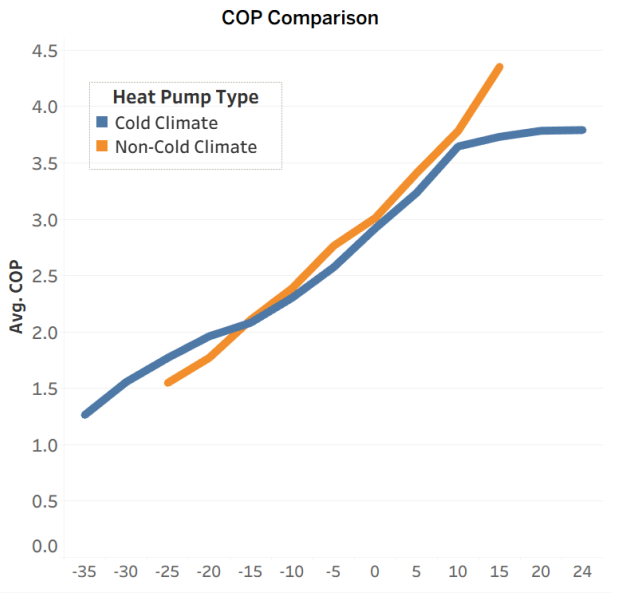
Figure 2: Heat pump performance correlates with temperature | Note: depicted performance contrast between cold climate heat pump and standard heat pump | Source: University of British Colombia, UBC, Aug 2025 (6)
3. Can heat pumps be powered by “low-emission electricity”?
We already discussed how gas and coal usage usually increases during winter months (Figure 3). When heating is most needed during cold spells (a) heat pumps lose efficiency or COP, and (b) the share of conventional fuels such as coal and gas rises to ensure reliability.
More importantly is the winter peak power logic. An additional heat pump that was not there before will require additional marginal power in that hour, increasing peak power demand. Peak power demand, especially during winters, will be mostly met by the usage of gas and coal, much more so than the average generation displayed in Figure 3. Therefore, marginal peak power demand will most likely be powered by conventional or fossil fuels!
Fact 4: Marginal winter peak power demand will mostly be served by gas and coal
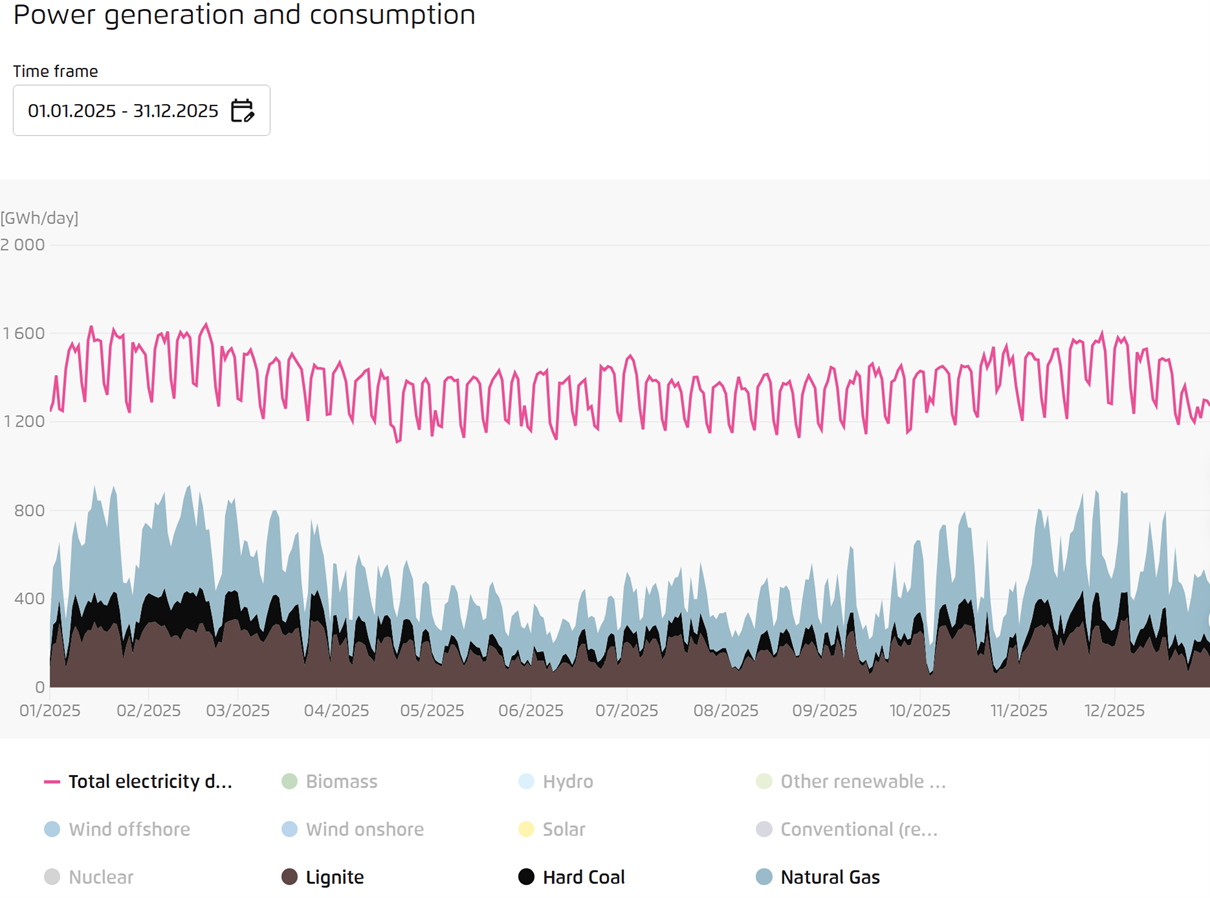
Figure 3: Germany power generation from coal and gas during 2025 | Source: Agora
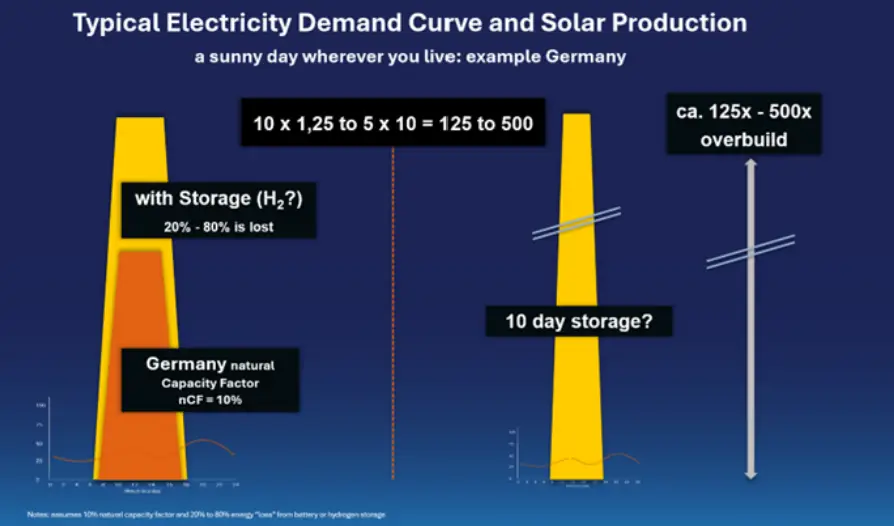
Figure 4: Solar overbuilding required to overcome 10 days of secure solar-only-based power during 10 days of insufficient sunshine using a) batteries or b) hydrogen for storage.
Note: Hydrogen comes with roughly 80% “energy loss” for storage and battery storage comes with at least 25% “energy loss”.
Peak power demand is projected to grow faster than base electricity demand due to electrification of EVs, heat pumps, data centers, AI, etc. The International Energy Agency (IEA) projection says peak demand could grow up to 80 % faster than total electricity demand by 2035 (see also 7).
Power grids and generation capacity must be sized for peak demand, not just total energy use, and current energy policies are not adding enough dispatchable capacity to meet those peaks.
The next question is whether wind and solar generated power is really “low-emission” or even good for the environment…
It is indeed possible that pure solar and wind-based energy systems have lower CO2-emissions than a pure coal and gas-based power system. However, the negative environmental impact of wind and solar at system level is much higher when one takes an honest look at the required overbuild, short duration storage, long duration storage, thermal backup and larger and more complex network integration and transmission infrastructure. That is because of their low net-energy efficiency (eROI) caused by
- Low energy density.
- Intermittency, and
- Short operational lifetime.
To understand the required overbuilding that may reach 125-500x for a 1:1 replacement of a gas or coal-fired power stations please watch this short video .
4. Are heat pumps secure and sustainable?
The question of whether heat pumps are secure and sustainable is largely location dependent. If you are in Scandinavia in a rural area with abundant hydro power and an ultra-secure grid, then a heat pump is probably not only more environmentally friendly but probably similarly secure as an oil or gas-based heating system.
However, I would argue having a sufficient quantity of your own fuel in your own garden to get you through the winter is always more secure than largely depending on grid power.
If you live in a large city and your grid is already exposed to an increased risks of blackout for whatever reasons (see Spain or Berlin or Chile in 2025, more here) then I would highly advise AGAINST heat pumps. Logically, ground-based heat pumps and even monoblock air heat-exchangers in cities are hardly an option. Cities require district heating and possibly some large-scale semi-district heat pump systems. Large-thermal power stations usually deliver district heating as a byproduct.
The sustainability aspect is more complex as “sustainability” is complex in itself. For me sustainability means being both economically and environmentally sound, without sacrificing one for the other.
Wind and solar-based power grids are largely NOT sustainable, mainly because of the vast overbuild required due to low energy density per m2 (volumetric) and per kg (gravimetric) of wind and solar based systems, leaving a big environmental footprint to be considered. For more details please see here – Are Wind and Solar up for the challenge?
Fact 5: Heat pumps are not secure in urban areas with higher risk grid-connections nor are they sustainable relying on grids with high wind and solar penetration.
Note: Monoblock air heat exchangers are vastly more common than ground systems (see Figure 5). Not because they are better but because they are cheaper, quicker, and easier to install than ground-based heat pumps. Monoblock heat pumps are also easier to subsidize and easier to deploy at scale. Ground-source heat pumps are thermodynamically better than any air-source heat pumps.
From a system perspective air monoblocks also bring worse winter COP, higher peak electricity demand, defrost losses, freeze-protection penalties, and come with louder urban environments.

Figure 5: Heat pump adoption by country | Source: Schernikau based on EHPA, Eurostat, NBER, DLT.ri.gov
Cyber and Physical Security
Energy security is not just about fuel. It is also about digital and physical resilience.
Heat pumps depend entirely on electricity and increasingly more on digital systems. Smart grids and remote monitoring expands the attack surface. A boiler with stored fuel can run largely independent of the wider system. A heat pump, on the other hand, cannot. If the grid fails, heating stops immediately.
Cyberattacks on energy infrastructure are no longer hypothetical. The more centralized and electrified the system becomes, the more critical cybersecurity becomes.
Physical security matters just as much. Power plants, substations, and transmission lines are strategic assets. Recent conflicts have shown how vulnerable energy infrastructure can be. Electrified heating increases the dependence on that infrastructure, which becomes even more critical during the winter months.
Resilience therefore depends on system design. Fully electrified heating without robust grid security increases exposure.
The real question is not just about efficiency, but also about resilience. See my blog on Cyber security and critical infrastructure.
5. Blackouts and Heat Pumps?
I was born in Berlin, Germany where the end December 2025 blackout affected almost 50,000 people for several days. This raises the question of.. what happens to heat pumps when there is a prolonged power interruption? The answer is simple and painful.
Berlin suburbs, like most of the world, mainly utilize monoblock heat pumps. (see also Figure 6) where the main heat exchanger sits on the outside the house.
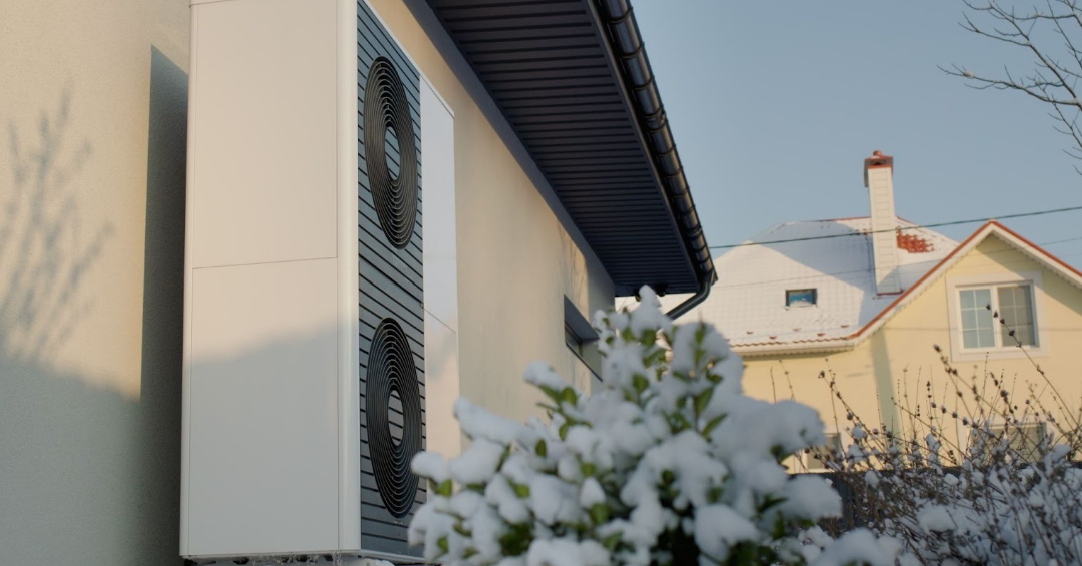
A typical monoblock heat pump in a Berlin suburb in the winter | Source: enter.de (9)
A heat pump requires electricity for its key components to function. (10) The compressor generates heat, while circulation pumps continuously pumps the heated water through the system. As soon as the power fails, this circulation stops immediately – and a critical chain reaction starts, this is precisely where the danger begins:
- The circulation pump stops – there is no more flow in the heating circuit.
- The stagnant water in pipes and heat exchangers begins to freeze due to sub-zero temperatures.
- Freezing water expands and can cause pipes, valves, and the heat exchanger to burst.
- Particularly critical for outdoor units directly exposed to weather conditions.
Reports from technicians in Berlin, in January 2026, after the power was restored noted many burst pipes, fittings, and heat pump damage because frozen water caused these components to crack. In several cases systems were considered as total losses and needed replacement, not just repair. So the heating was often NOT restored after the power was turned back on (11).
For more details on blackouts and what causes them please read my blog post, written after the large April 2025 Spanish blackout caused by overreliance on solar.
Fact 6: Heat pump systems (especially outdoor air heat exchange systems) are prone to bursting when exposed to sub-zero temperatures during power interruptions for extended period of times.
6. Summary
Fact 7: Subsidies are correlated with higher heat pump adoption, particularly when they are stable, generous, and combined with other policies in this regard.
A possible urban solution is district heating integrated with large-scale ground- or water-source heat pumps and thermal storage.
Heat pump sales are largely, though not exclusively, driven by subsidies. For example, according to the European Heat Pump Association, heat pump sales in Europe dropped over 20% in 2024 after reduced subsidy and policy support as well as policy uncertainty in various countries. (9), see Figure 6.
Let’s go over the 6 facts we have concluded again:
Fact 1: Transferring heat from place to place may take 3x less work (or energy) than cooling or heating directly
—
Fact 2: COP or CP = Coefficient of Performance DOES NOT equal system efficiency of a heatpump!
—
Fact 3: The coefficient of performance – COP of heat pumps decreases the colder it gets
—
Fact 4: Marginal winter peak power demand will mostly be served by gas and coal.
—
Fact 5: Heat pumps are not secure in urban areas with higher risk grid-connections nor are they sustainable relying on grids with high wind and solar penetration.
—
Fact 6: Heat pump systems (especially outdoor air heat exchange systems) are prone to bursting when exposed to sub-zero temperatures during power interruptions for extended period of times.
—
Fact 7: Subsidies are correlated with higher heat pump adoption, particularly when they are stable, generous, and combined with other policies in this regard.
If you are interested in all things energy and if you enjoy having these “unpopular” discussions, be sure to read my other blog posts as well as reading our book – The Unpopular Truth about Electricity and the Future of Energy
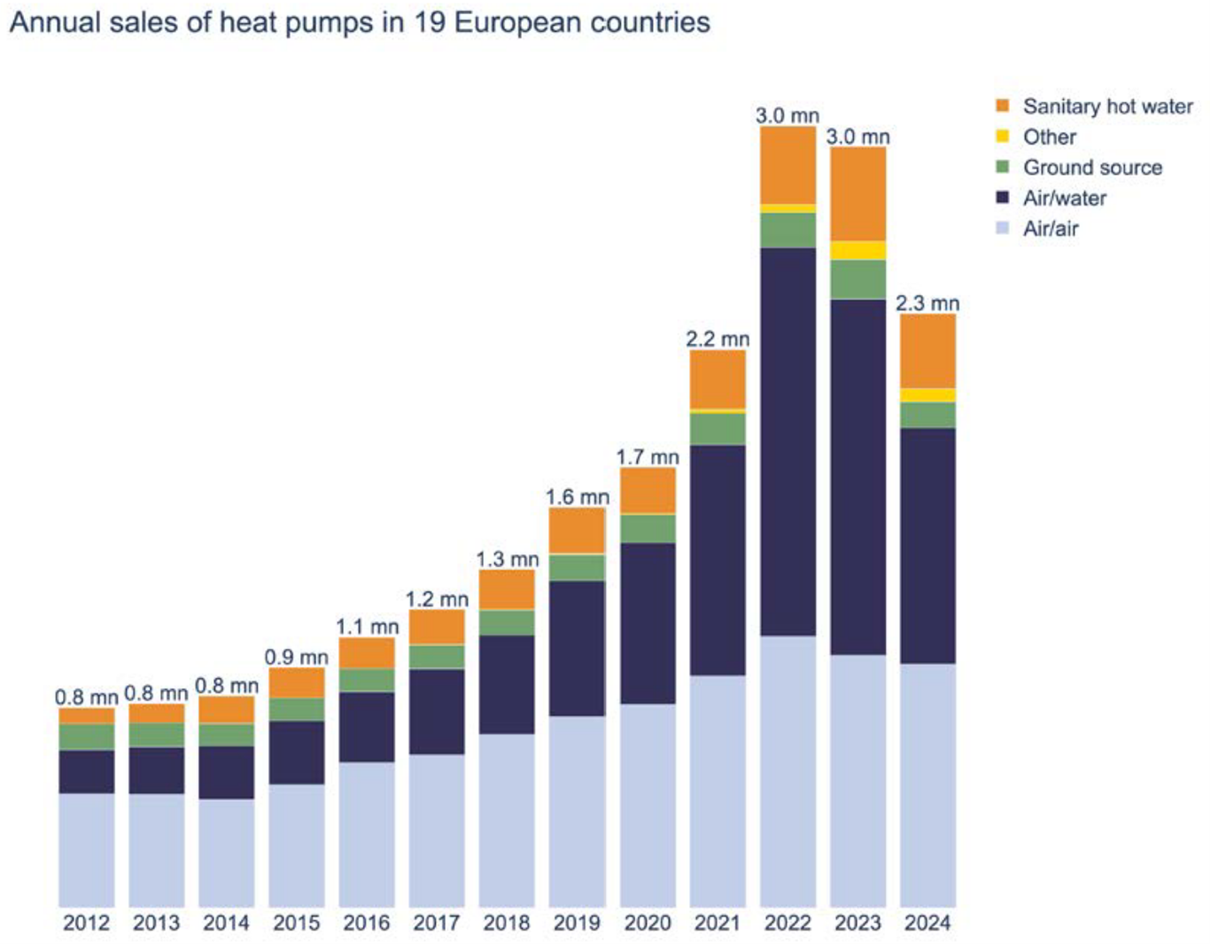
Figure 6: Annual heat pump sales in Europe, 2012-2024 | Note: air conditions are also heat pumps, look at ground source heat pumps, these are purely for heating and they dropped to levels of 2019 | Source: European Heat Pump Association EHPA (9)
Links and Resources
1. IEA and OECD. IEA: The Future of Heat Pumps. OECD, 2022. (link)
2. GSU 2021, Georgia State University, on heat pumps, Dec 2021, (link)
3. DOE: Department of Energy Issues Report Evaluating Impact of Greenhouse Gasses on U.S. Climate, Invites Public Comment. 2025. (link)
4. IEA: Germany 2025 – Analysis. 2025. (link)
5. Fraunhofer ISE Research Project Completed: Heat Pumps Provide Climate-Friendly Heating in Existing Buildings – Fraunhofer ISE.” November 3, 2025. (link)
6. Heat Pump Performance in Part 9 Residential Homes Across Climate Zones. University of British Columbia, UBC, 2025. (link)
7. IEA: Electricity 2025 – Analysis. 2025. (link)
8. Morgan, JP. JP Morgan: Annual Energy Paper – The Elephants in the Room. 2022. (link)
9. EHPA-Market-Report-2025-Executive-Summary. European Heat Pump Association, 2025. (link)
10. “Wärmepumpen Bei Frost Und Stromausfall: Was Passieren Kann, Wie Man Vorbeugt | Heise Online.” Accessed January 22, 2026. (link)
11. News, Blackout. Frost Damage after Blackout: Power Restored – Many Heating Systems Still Remain Off. January 13, 2026. (link)
[1] IEA 2024, Batteries and Secure Energy Transitions – Analysis, April 2024, (link)
[2] Prof Lion Hirth on storing electricity vs oil gas, July 2025, (link)
[3] DeSantis et al 2021: Cost of Long-Distance Energy Transmission by Different Carriers, iScience 24, no. 12 (2021): 103495, (link)
[4] “NetZeroWatch: Gridscale Batteries and Fire Risk,” October 2024, (link)
[5] BloombergNEF, Global Energy Storage Growth Upheld by New Markets | BloombergNEF, June 2025, (link)
[6] NREL 2024, Batteries – 2024 Cost Components,” NREL, 2024, (link)
[7] RenewEconomy on Utlity Scale Battery costs… ‘Watershed Moment:’ Big Battery Storage Prices Hit Record Low in Huge China Auction,” RenewEconomy (blog), July 2025, (link)
[7a] Schandl et al 2024: Global Material Flows and Resource Productivity: The 2024 Update, Journal of Industrial Ecology 28, no. 6 (2024): 2012–31 (link)
[8] Michaux 2024: Estimation of the Quantity of Metals to Phase out Fossil Fuels in a Full System Replacement, Compared to Mineral Resources – Publications, Reports, Maps and Posters,” Hakku, August 2024, (link)
[9] Material and energy balance as well as ore ratios are based on a number of sources, including but not limited to Schernikau research and analysis, dozen of industry interviews, Prof Simon Michaux, miningforzambia.com, lithiumharvest.com, inchem.org, USGS, natural-resources.canada.ca, IEA, Cobalt Institute, Int’l Aluminum Institute, Michala et al 2025, Zhang et al 2022, Mohr et al 2020, LBNL 2022 ‘Cost and Material Composition of Power Electronics in Grid Applications’, BNEF 2022–2023 ‘Inverter Material Supply Chains’, Tesla Megapack teardown (Munro & Associates, 2022)
[10] Information on Gigafactory Energy use are based on
- Degen et al. (2023), Nature Energy (link)
- Kuki et al. (2025), MDPI Environments (link)
- Fraunhofer FFB Study, (link)
- DOE Energy Storage Durability (2024) (link)
- MDPI Batteries (2024), Pack Assembly (link)
- IEA Commentary (2024) (link)
[11] Fordham et al 2021, (link)
[12] Marlair et al 20xxx, (link)
[13] ABC. News, “Lithium Batteries Could Spark ‘Catastrophic’ Plane Fires, FAA Warns,” ABC News, March 2022, (link)
[14] Battery Fires and risks
- “World’s Largest Battery Plant on Fire in Central California – POLITICO,” January 2025, (link)
- “A Lithium-Ion Battery Fire in a Cargo Ship’s Hold Is out after Several Days of Burning,” AP News, January 2024, sec. Business, (link)
- “China Bans Uncertified and Recalled Power Banks on Planes,” Reuters, June 27, 2025, sec. Technology, (link)
[15] Bridging the Fire Protection Gaps: Fire and Explosion Risks in Grid-Scale Battery Storage,”April 2025, (link)
[15a] Benchmark, May 2025,(link)
[16] China Dominates May Global Deployments with 11.2GWh” Energy-Storage.News, June 10, 2025, (link)
[17] Julien Jomaux, “LI: Jomaux on Europe Grid Batteries,” May 2025, (link)
[18] BESS technologies and the information provided are based on various sources, including but not limited to [1] above; BloombergNEF Energy Storage Market Outlook Q2 2025; NGK Sodium-Sulfur Technical Brochure 2025; Sumitomo Redox Flow Brochure 2025, India Institute of Science Na-Ion Research, 2024; DOE Battery Lifetime Study 2024